

By Sebastian Kaz | S² Luxury Group | Compass
Miami’s luxury real estate market in 2026 is not one market. It is two, operating side by side, and understanding which one you are in makes all the difference.
After three years of historic price appreciation and frenzied buyer competition, the broader Miami-Dade market has settled into a more measured rhythm. Inventory is up, days on market have extended, and buyers have recovered negotiating leverage they have not had since before the pandemic. At the same time, the ultra-luxury segment, properties priced at $5 million and above in prime neighborhoods, is behaving as if none of that applies. The best assets continue to move quickly, often privately, and frequently at or near asking price.
This is what I mean when I say the numbers matter, but only if you know how to read them.
The Broad Market: More Inventory, More Time, More Leverage
According to the Miami Association of Realtors, the median single-family home price in Miami-Dade reached $699,990 in January 2026, up 3.7% year-over-year. That is healthy, sustained appreciation, not a spike. What is more telling for buyers is that active listings across Miami-Dade now total approximately 17,900 units, up roughly 5.6% from the prior year, though still about 25% below 2019 levels.
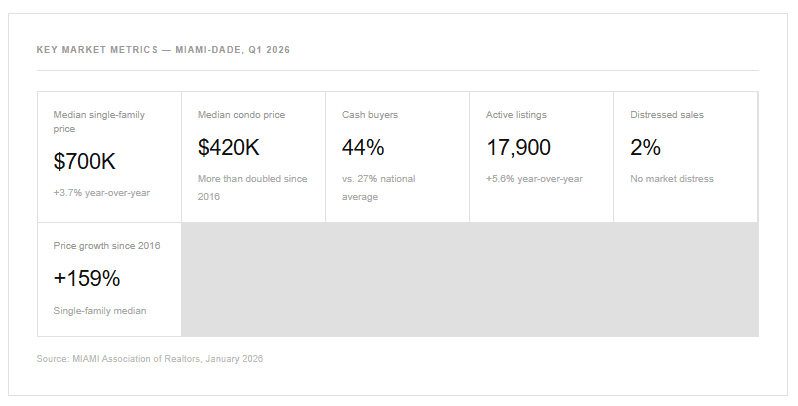
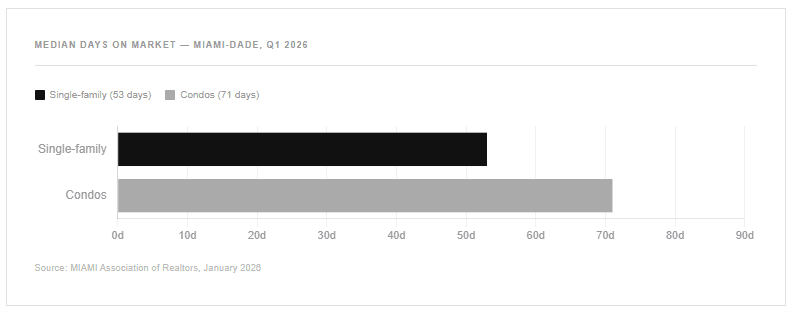
Single-family homes are spending a median of 53 days on the market. Condos are averaging 71 days. Sellers are receiving approximately 94% and 93% of list price, respectively. This means the market has rebalanced, but it has not reversed. Distressed sales account for just 2% of closings, a fraction of what they represented during the 2009 crisis. There is no capitulation here. There is discipline, selectivity, and a more deliberate pace.
For buyers, this creates a meaningful window. The bidding wars that defined 2021 and 2022 are largely gone. There is time to perform proper due diligence, negotiate on terms, and evaluate options without artificial urgency. For sellers, the lesson is equally clear: pricing discipline matters more today than at any point in the past five years. Overpriced listings are sitting. Well-positioned ones are still closing.
The Luxury Segment: A Different Conversation Entirely
Above the $5 million threshold, and especially above $10 million, the dynamics shift considerably.
Transactions in the ultra-luxury tier (properties above $10 million) continue to operate in a scarcity-driven environment. In neighborhoods like Coconut Grove, Coral Gables, and prime Miami Beach, exceptional waterfront homes and trophy assets regularly transact privately, with zero public market exposure. The best product never reaches Zillow. It moves through relationships, and the buyers who access it are connected to advisors with those relationships.
Miami Beach is instructive. Q3-Q4 2025 closed sales data shows that the trophy single-family tier ($15M to $34M) is characterized by private, relationship-driven transactions with near-zero days on market. South of Fifth luxury condos remain among the most in-demand assets in the city, with persistent buyer interest and tight inventory in buildings like Continuum and Faena House.
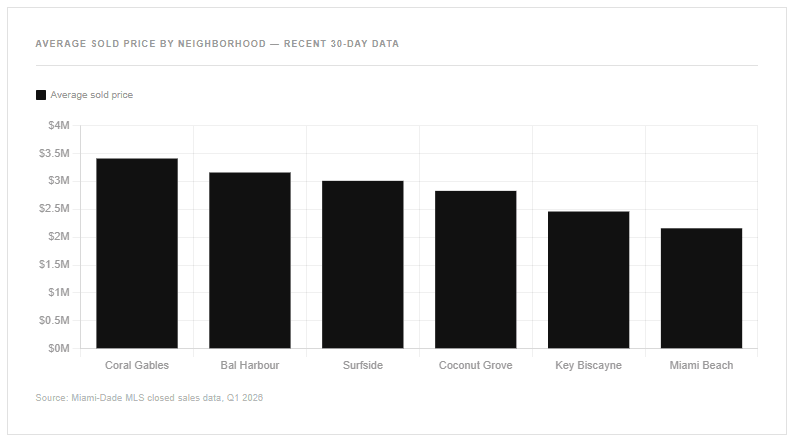
In Coral Gables, the market has been described by multiple analysts as “on fire.” Average sold prices in the neighborhood topped $3.4 million over the most recent 30-day period, the highest of any Miami submarket tracked. Coconut Grove followed closely, with average sold prices approaching $2.8 million. These are not anomalies. They reflect a sustained pattern of demand from both relocating domestic buyers and international capital seeking the stability and lifestyle that these neighborhoods consistently deliver.
Cash Is Still King
One of the most important structural features of Miami’s luxury market is the continued dominance of cash buyers. All-cash purchases accounted for 44% of January 2026 closings across Miami-Dade, well above the national average of roughly 27%. In the $1 million-plus segment, that percentage is even higher.
This matters for several reasons. First, it insulates the luxury market from mortgage rate volatility. When 30-year fixed rates sit at 6.3% as they do today, financed buyers feel real affordability pressure. Cash buyers do not. Second, it reflects the nature of Miami’s buyer pool: high-net-worth individuals, whether relocating from New York or arriving from Latin America or Europe, who are making deliberate, long-horizon decisions about where to place capital. These are not rate-sensitive transactions. They are lifestyle and wealth-preservation decisions.
The International Factor
Miami’s global character is not a talking point. It is a measurable, data-backed reality that directly shapes how the luxury market performs.
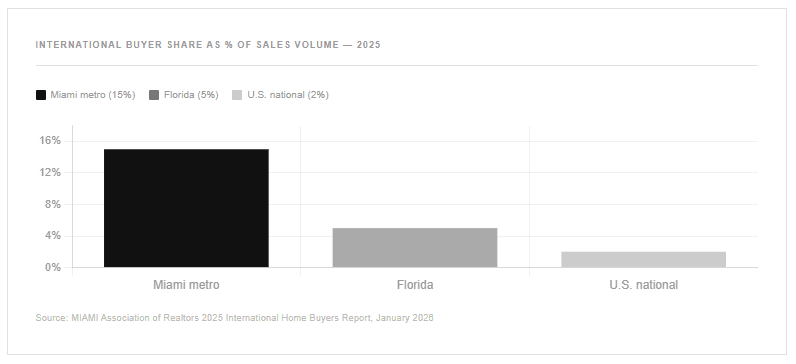
According to the MIAMI Association of Realtors’ 2025 International Home Buyers Report, international buyers accounted for 15% of residential sales volume in the Miami metro area in 2025. That figure is seven times the national average of 2%, and three times Florida’s state average of 5%. Foreign buyers acquired more than 5,300 properties in South Florida in 2025, up from approximately 4,000 the prior year. Total international purchase volume reached $4.4 billion, a 42% increase year-over-year and the highest of any U.S. market.
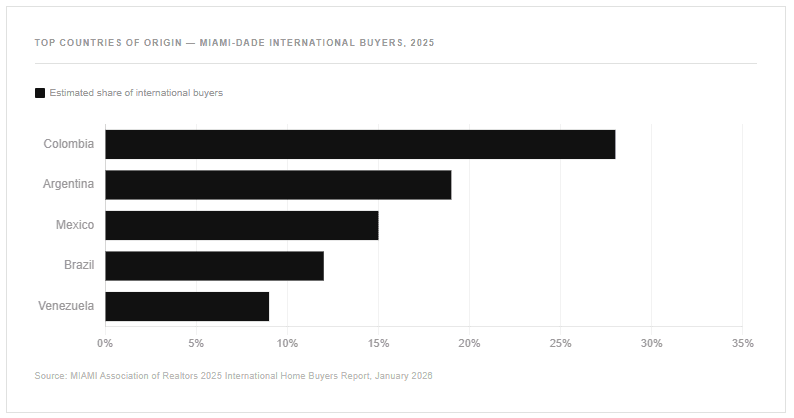
Latin American buyers continue to lead, with Colombia and Argentina ranking first and second in Miami-Dade buyer origin, followed by Mexico, Brazil, and Venezuela. These buyers are not purchasing vacation homes. They are preserving capital in dollars, diversifying away from political and economic risk at home, and seeking a proven market with strong liquidity and rule of law. At the same time, European buyers from France, Germany, and the United Kingdom are becoming increasingly active, particularly in Miami Beach and the Design District, alongside growing interest from Middle Eastern and Asian investors.
For international buyers reading this: Miami’s ownership laws apply equally to foreign and domestic purchasers. There are no citizenship or residency restrictions on buying real estate in Florida.
What This Means If You Are Buying, Selling, or Watching
If you are a buyer in the $1M to $5M range, 2026 is one of the best entry windows in several years. Inventory is the highest it has been in a decade in many segments. You have time, negotiating room, and access to properties that would have been under contract within days just two years ago. Move deliberately, but do not mistake a balanced market for a declining one.
If you are a buyer at $5M and above, the window looks different. Trophy assets in Coconut Grove, Coral Gables, and prime Miami Beach are not sitting. The best of them are not publicly listed. If you are waiting to see them on a search portal, you are likely already too late. Access in this segment comes through relationships, not algorithms.
If you are a seller, the answer is not to wait for another 2022. The fundamentals are strong and appreciation has continued, but the days of buyers absorbing any price without question are over. Proper positioning, honest pricing, and a targeted buyer outreach strategy are what separate successful listings from stale ones.
If you are watching from abroad and wondering whether Miami’s run is over, consider this: median single-family values have risen more than 159% since 2016. Prices have increased in 168 of the past 170 months. And Miami still offers more prime residential space per dollar than Monaco, London, or New York. The structural case has not changed.
A Final Thought
I have been watching this market for decades, from my early years in real estate in Los Angeles to thirty years of living and working in Miami. What makes this city different is not just the weather or the tax environment, though both matter. It is the sustained convergence of global wealth, genuine lifestyle appeal, and a level of liquidity that few markets in the world can match.
The numbers in 2026 are telling a nuanced story. It is not a boom. It is not a correction. It is a maturing market operating at a high level, with clear winners and clear losers depending on how well you understand what you are looking at.
That is where the right advisor makes all the difference.
Sebastian Kaz is co-founder of S² Luxury Group at Compass, specializing in luxury residential and commercial real estate across Coconut Grove, Coral Gables, Downtown Miami, and Miami Beach. Data referenced in this article is sourced from the MIAMI Association of Realtors, Miami-Dade County MLS closed sales records, and published market reports current as of Q1 2026. This article is intended for informational purposes only and does not constitute financial or legal advice.
Sources: MIAMI Association of Realtors 2025 International Home Buyers Report (January 2026); Benoit Properties Miami Housing Market 2026 Report; David Siddons Group Q1 2026 Miami Real Estate Market Report; Carlo DiPasquale Miami Beach Luxury Real Estate Analysis 2026.