

Coconut Grove vs. Coral Gables: How to Choose Between Miami's Two Most Elegant Neighborhoods
By Suzanne Anderson | S² Luxury Group | Compass
I grew up in Miami. I have lived in Coconut Grove, Coral Gables, Key Biscayne, and Pinecrest at different points in my life, and I have helped clients find their homes in all of them. So when someone asks me whether they should be in the Grove or the Gables, I take the question personally, because I have actually lived the answer.
Both neighborhoods are exceptional. Both are among the most consistently desirable addresses in South Florida. But they are not interchangeable, and the clients who thrive in one are often quite different from the clients who thrive in the other. Here is how I think about it after decades of working and living in both.
The Feel of Each Neighborhood
Coconut Grove is Miami’s oldest neighborhood, and it wears that history comfortably. The streets wind under a canopy of old-growth trees. The architecture is eclectic, ranging from mid-century modern to Mediterranean revival to bold new construction, and it all somehow coexists without friction. The pace is slower than the rest of the city in the best possible way. The Grove has always attracted people who want to live beautifully and quietly, who value the waterfront and the village feel over prestige and formality.
I lived in the Grove, and what I remember most is the sense of community. You know your neighbors. You walk to dinner. You end up at the Dinner Key waterfront on a Sunday afternoon without really having planned it. For a city with Miami’s energy and pace, the Grove offers something genuinely rare: a neighborhood that feels like a neighborhood.
Coral Gables is a different kind of beautiful. It was planned from the beginning by George Merrick in the 1920s, and you feel that intentionality in every block. The Mediterranean Revival architecture is cohesive and grand. The streets are broad and lined with banyan trees. The Miracle Mile has matured into a genuine destination for dining, boutique retail, and culture. The Biltmore anchors the whole thing with a sense of civic permanence that few Miami landmarks can match.
I lived in Coral Gables too, and what strikes me most in retrospect is how complete it feels. Everything you need is there: the schools, the restaurants, the cultural institutions, the gated estate enclaves, and it is organized in a way that makes daily life feel considered rather than improvised. For clients who are accustomed to that kind of urban coherence, whether from a city like Barcelona or Buenos Aires or from a well-established American suburb, Coral Gables tends to feel immediately right.
What Your Money Buys in Each Market
Both neighborhoods sit firmly at the top of Miami’s residential market, and neither should be approached as a place to find a deal. What you are buying in either case is something that has held and built value for decades, and that track record is worth understanding.
In Coconut Grove, the market centers on single-family homes and a carefully curated selection of boutique condo buildings. Inventory is structurally limited, the neighborhood has resisted high-density development, and the result is a market where demand consistently outpaces supply at the top end. Average sold prices have reached approximately $2.8 million, with waterfront and bayfront properties regularly transacting well above $5 million. New ultra-luxury developments like Vita at Grove Isle have entered at starting prices around $6.5 million, reinforcing the Grove’s position at Miami’s highest residential tier.
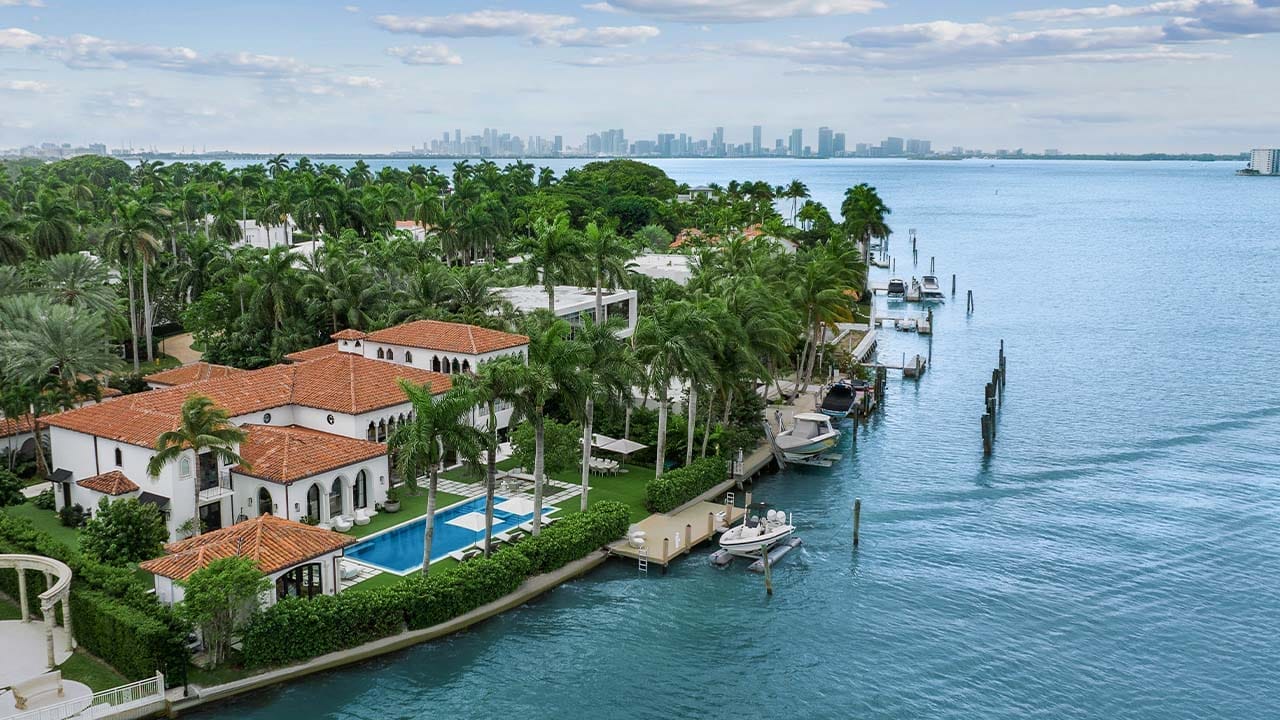
In Coral Gables, the story is similar but the numbers are even higher. Recent data shows average closed prices approaching $3.4 million across the neighborhood, the highest of any tracked Miami submarket. Estate properties in Gables Estates, Cocoplum, and Tahiti Beach trade between $5 million and well above $20 million. The Gables also has a more developed condo market, from boutique mid-rise buildings near the Miracle Mile to waterfront towers along the neighborhood’s northern edge.
What both markets share is a heavy cash buyer presence and a general indifference to the mortgage rate environment that shapes decisions elsewhere in the city. The buyers here are making long-term decisions about where to live and where to place capital, and those decisions are not particularly sensitive to whether rates are at 6% or 7%.
Schools: Where the Gables Has a Structural Advantage
If you have school-age children and public school quality is a factor in your decision, this section matters.
Coral Gables is home to Coral Gables Senior High School, one of the consistently highest-rated public high schools in Florida, with a strong International Baccalaureate program. The neighborhood also sits within proximity to several well-regarded K-8 schools and feeds naturally into some of Miami’s best private institutions, including Ransom Everglades and Gulliver Schools.
Coconut Grove families have access to many of the same private school options, and Coconut Grove Elementary is a strong public option at the elementary level. But for families where the public high school path is important, Coral Gables has the built-in advantage.
If private schooling is the plan regardless of neighborhood, this distinction becomes less decisive. Both neighborhoods offer comparable access to the best private schools in Miami-Dade.
Daily Life: Two Different Rhythms
Coconut Grove is walkable in a way that surprises people who associate Miami with cars and sprawl. The village center is genuinely accessible on foot from most Grove addresses, with restaurants, coffee shops, boutiques, and the CocoWalk complex within easy reach for many residents. Dinner Key Marina puts sailing and boating practically at your doorstep. Brickell and Downtown are roughly ten minutes away. The Grove manages to feel removed from the city’s intensity without actually being far from anything.
Coral Gables operates at a slightly higher register of civic life. The Miracle Mile dining and retail corridor has expanded significantly over the past decade. The Coral Gables Museum, Actors’ Playhouse at the Miracle Theatre, and the broader cultural programming the city supports give it a density of community engagement that is unusual in Miami. The Biltmore Hotel’s golf course and pool are genuinely part of the social fabric for many Gables residents. For clients who want a neighborhood that functions as a full community, not just a residential address, Coral Gables often delivers more infrastructure.
Who Belongs in Each
After decades of helping clients navigate this decision, I have noticed some consistent patterns.
Coconut Grove tends to resonate most with families and individuals who prioritize lifestyle over prestige; people drawn to waterfront access, mature trees, and a village-scale community; creative professionals and entrepreneurs who want proximity to the city without being absorbed by it; boating and outdoor enthusiasts; and international buyers, particularly from South America and Europe, who respond immediately to the neighborhood’s organic character and waterfront access.
Coral Gables tends to resonate most with families where top-rated public schools are a priority; corporate executives and finance professionals who value the neighborhood’s established reputation; international buyers seeking a prestigious address with gated community options and strong architectural character; buyers who want a larger estate footprint; and clients who place high value on walkable retail, cultural programming, and civic infrastructure.
I want to be honest about one thing: a significant number of my clients look seriously at both neighborhoods before deciding. That is not indecision. That is the right process. The best way to understand the difference is to spend time in both, at different hours, on a weekday and a weekend. The character of a neighborhood reveals itself in its rhythm, not its listing price.
The Long-Term Outlook
Both neighborhoods are positioned to continue outperforming the broader Miami-Dade market for the same structural reason: supply is constrained and demand is not.
Coconut Grove has limited developable land and a community that actively resists high-density development. What new construction exists tends to be architect-designed single-family homes replacing older stock, and the quality bar is high. Coral Gables has architectural review requirements, deed restrictions, and a city government with a long track record of protecting its character. These mechanisms preserve the very qualities that make both neighborhoods desirable, which in turn preserves and builds value over time.
For buyers considering either neighborhood as a long-term hold, the case is straightforward. The supply will not increase meaningfully. The demand, driven by relocating domestic buyers and sustained international capital, will not diminish. What you are really buying is scarcity in one of the most livable urban settings in the United States.
A Personal Note
People sometimes ask me which one I prefer. My honest answer is that I loved living in both for different reasons at different stages of my life. The Grove gave me community and proximity to the water in a way that felt like home from the first week. The Gables gave me a sense of permanence and civic pride that I did not expect to value as much as I did.
What I can tell you with certainty is that neither neighborhood disappoints. The question is which one fits your life right now, and which one you can see fitting your life ten years from now. That is the conversation I enjoy having most, and it is one I welcome you to start.
Suzanne Anderson is co-founder of S² Luxury Group at Compass and a lifelong Miami resident. She has lived in Coconut Grove, Coral Gables, Key Biscayne, and Pinecrest, and has spent decades helping clients find their homes across South Florida’s most sought-after communities. She is a member of the Master Brokers Forum and holds multiple professional designations in residential and commercial real estate. Market data referenced in this article reflects current Miami-Dade MLS statistics as of Q1 2026. School information should be independently verified with Miami-Dade County Public Schools and individual institutions.